
Connectomics in worms
The wiring architecture of neuronal networks is assumed to be a strong determinant of their dynamical computations. An ongoing effort in neuroscience is therefore to generate comprehensive synapse-resolution connectomes alongside brain-wide activity maps. However, the structure-function relationship, i.e. how the anatomical connectome and neuronal dynamics relate to each other on a global scale remains unsolved. To address this, we systematically compared graph features in the C. elegans connectome with correlations in nervous system wide neuronal dynamics obtained from whole brain Ca2+-imaging (Figure 1, upper panels). We found that direct connectivity is a weak predictor of neuronal interactions. However, non-local connectivity features such as specific triplet motifs or similarity measures in network neighborhoods (e.g., input similarities) correlate well with functional interactions between neurons (Figure 1, lower panels). Surprisingly, quantities such as connection strength or the amount of common inputs do not improve these predictions, suggesting that the network’s topology is sufficient. We demonstrate that highly interconnected hub neurons (termed rich club neurons) in the connectome are key to these relevant graph features. Consistently, inhibition of multiple hub neurons specifically disrupts brain-wide activity dynamics. Thus, we propose that the rich club hub-architecture and non-local connectivity features provide an anatomical substrate for coordinated global brain dynamics and that neuronal communication within circuits cannot be fully understood when studied in isolation but within the full context of the connectome (Uzel et al., 2022, Current Biology).
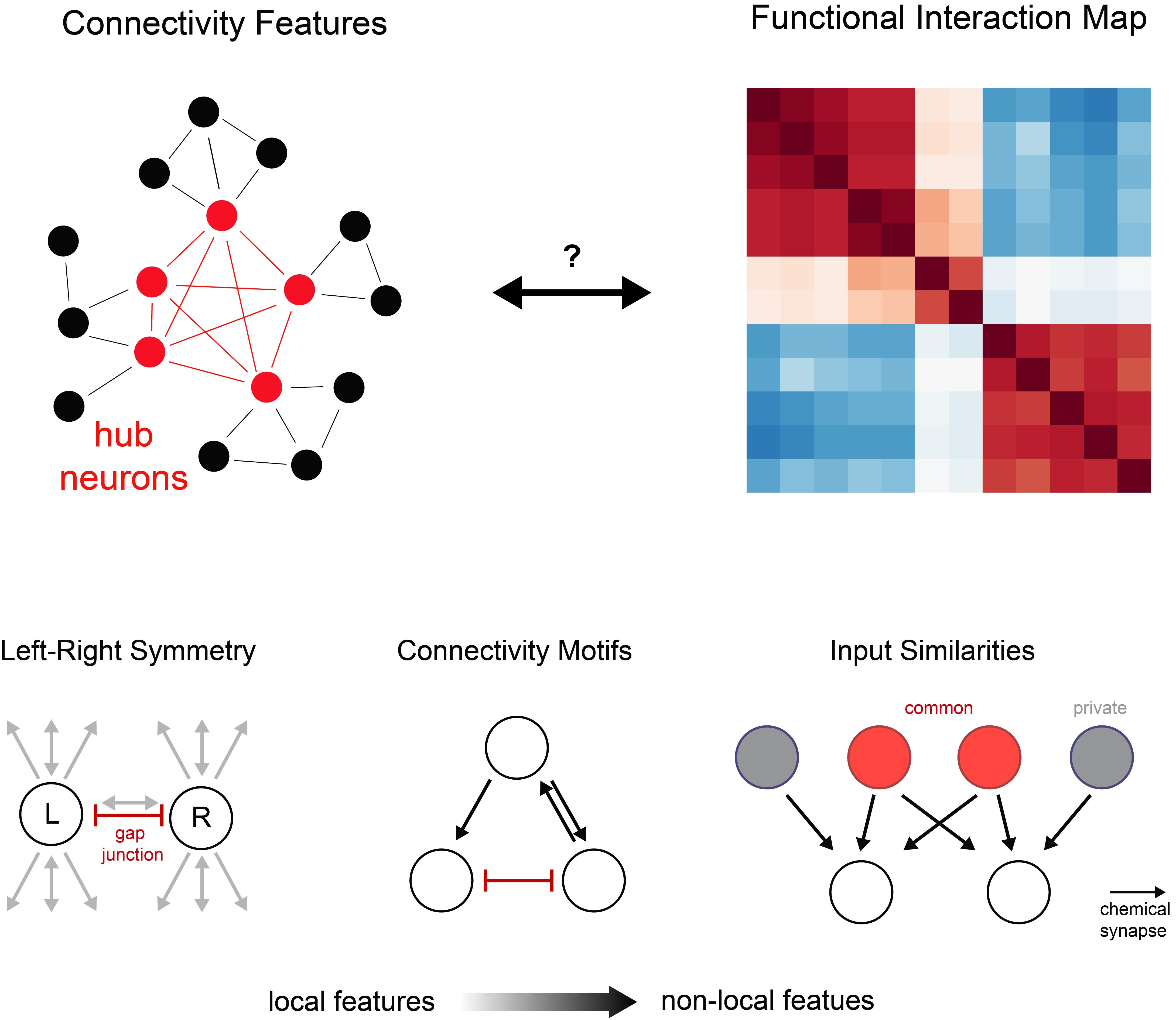
Figure 1. We compared the connectome (upper left) with brain interaction maps (upper right); both simplified schematics. Functional interactions between neurons are supported by GAP junctions but are best understood by connectome context, like triplet motifs and input similarities, rather than by direct connectivity (lower panels). The rich hub architecture (schematized in upper rihght panel) is crucial for establishing this context. Adapted from (Uzel, 2022, Current Biology)